
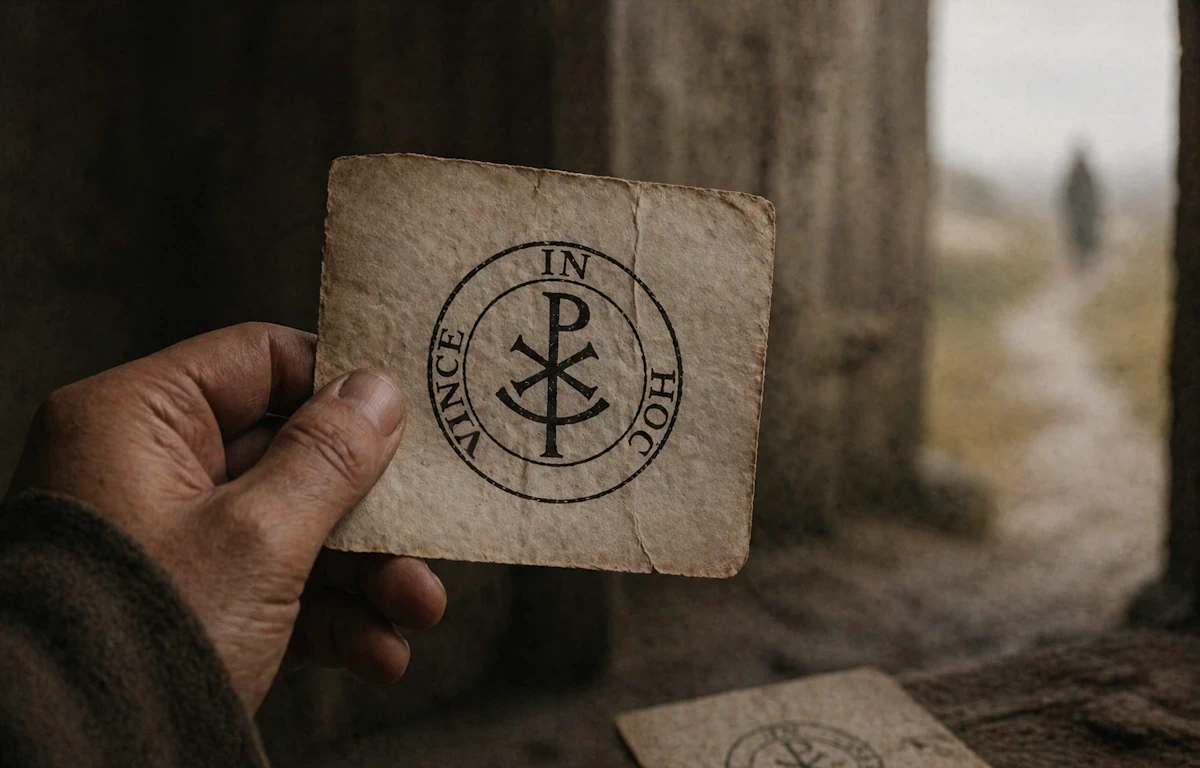
A man stands at the edge of enemy territory, about to cross into danger. He does not draw a weapon. He does not seek a priest. Instead, he quietly repeats a short phrase three times and carries a scrap of paper covered in circles, letters, and a cross.
To him, this is protection.
For centuries, texts like the Enchiridion of Pope Leo III promised exactly that: safety in battle, protection from enemies, and defense against illness, misfortune, and unseen threats. They speak the language of Christianity, invoking Christ, the Cross, and divine names, yet arrange that language with unusual precision. Phrases are repeated a set number of times. Symbols appear in fixed forms. Outcomes are implied rather than argued.
Modern readers tend to separate religion and magic into neat categories. The people using these books had less reason to do so.
Life in the early modern period did not offer much stability. Travel carried risk, even over short distances. Illness could appear without warning and spread quickly. Conflict lingered in the background, whether through war, raids, or local disputes.
Religion provided meaning and structure, along with promises about the next life. It did not always address immediate danger in a direct way.
In that environment, a small, repeatable act of protection had clear appeal. It could be carried, remembered, and performed without assistance. That is the space this book occupies.
The Enchiridion of Pope Leo III reads less like theology and more like instruction. It does not dwell on belief or doctrine. It focuses on use.
Phrases are paired with directions about when to say them and how often, sometimes with surprising specificity. Words are tied to posture, timing, or circumstance. The structure suggests that sequence matters, as though the order itself carries weight. Prayer remains grounded in Christian authority, but here it is handled like a procedure.
At times, the text becomes unusually direct:
Oraison pour empêcher un fusil de tirer, dites croisant la jambe gauche sur la droite.
Prayer to prevent a rifle from firing, said while crossing the left leg over the right.
Followed by:
Non tradas Dominum nostrum Jesum Christum. Amen.
Do not betray our Lord Jesus Christ. Amen.
No explanation is offered. A position of the body, a short phrase, and an expected result are presented as a complete unit. The gesture is not described as symbolic. It is simply part of the act.
Seen this way, the boundary between prayer and technique begins to blur. The text does not ask for reflection. It assumes that correct performance is enough.
Stories attached to the text reinforce this impression. References to figures like Charlemagne present the material as something already tested. Whether those claims are reliable is unclear. Their purpose is easier to see. They place the reader among users rather than observers.
Despite its title, the Enchiridion is not a work of Pope Leo III. It was likely compiled in the early modern period and only later attributed to him. The name supplies authority. The structure supplies credibility.
The diagrams scattered through the Enchiridion do not behave like traditional religious imagery. There are no saints, no narrative scenes, and no attempt to explain doctrine through illustration. They are reduced to form and arrangement.
Most follow a consistent structure. A circle encloses another circle, and within that inner space sit letters, crosses, or compact symbols arranged with careful balance. This repetition of format matters. It creates a visual pattern that can be recognized even when the details change. The outer ring defines a boundary. The inner space contains the active elements. The center draws the eye and holds it there.
Within that framework, variation is controlled rather than free. Some designs distribute letters evenly around the circle, creating a sense of rotation. Others cluster forms toward the center, tightening the composition until it becomes dense and difficult to parse at a glance. In both cases, the arrangement feels deliberate. The elements are placed, not illustrated.
One symbol appears repeatedly. A Chi-Rho Christogram sits at the center, encircled by the phrase In Hoc Vince. Its repetition across multiple figures gives it a cumulative effect. It begins to function less as an individual image and more as a recurring mark, something applied rather than depicted.
Other diagrams introduce clearer relationships. A key-and-lock figure places two opposing shapes in alignment, joined at a central point. The image suggests opening and closing, access and restriction, without spelling those ideas out. The instruction attached to it directs the reader to recite a phrase when approaching enemies. The diagram and the action meet at the same moment.
A different figure is organized as a sequence. Stages are labeled and arranged from top to bottom, ending in a form identified as a serpent. The layout guides the eye downward. It does not explain what changes from one stage to the next. It establishes a progression to be followed.
This sequence shows change across stages without explaining it in words. The first form is breached by an arrow, suggesting entry or contact. The second becomes structured, enclosed by a ring of letters that impose pattern. The following stages tighten and simplify, reducing the form to smaller, more controlled shapes. By the time the figure reaches its final state, labeled Serpens, it has shifted from an abstract arrangement into something named and embodied.
The diagram does not clarify what is being transformed or why a serpent marks the conclusion. It presents the steps without interpretation. The meaning, if there is one, seems tied to carrying out or reproducing the sequence rather than explaining it.
Some designs resist even this level of reading. Dense geometric forms compress lines into tight intersections that are hard to separate visually. Monograms combine multiple letters into a single mark that cannot be easily broken apart. A few figures reduce further into minimal shapes that hover between symbol and script.
They do not clarify themselves. Their function does not depend on interpretation. What matters is that they can be reproduced, recognized, and used in the correct context. Accuracy of form appears to take precedence over clarity of meaning.
Hinged Double-Bar Symbol with Central Shaft
One figure stands out to a modern reader: a five-pointed star enclosed within a circle. The shape is immediately recognizable as a pentagram, and it carries strong associations today that suggest the occult or even the demonic. In this context, those associations are misleading. The figure appears alongside material concerned with misfortune and protection, and it follows the same visual logic as the other diagrams. It is contained, structured, and presented without explanation.
Rather than marking a break from the rest of the text, the pentagram fits within it. Its familiarity highlights a broader issue. Symbols that seem fixed in meaning now were far more flexible in earlier periods. What looks like a charged or dangerous image to a modern eye may have functioned here as another controlled form, one more element in a system built on repetition, arrangement, and use.
By the standards of other grimoires, these images are almost plain. Lines are thick. Details are limited. Compared to the elaborate constructions in texts like the Key of Solomon, they feel reduced.
That simplicity has practical roots. These images were likely produced as woodcuts for repeated printing. Fine detail increased cost and fragility. Bold lines reproduced more reliably and could be copied by hand with fewer errors.
The design follows use. These symbols needed to be clear, repeatable, and immediately recognizable. They were not meant for extended study.
This is ritual compressed into a portable form.
The book does not stand alone. Other grimoires rely on similar principles, though they operate at a different scale.
In the Key of Solomon, diagrams expand into constructed spaces. Circles contain grids of characters. Additional rings define boundaries. Words mark direction. These are not objects to carry but environments to prepare and enter.
The contrast is simple. The Enchiridion condenses. Other grimoires expand.
One fits in the hand. The other takes up a room.
From a modern perspective, the tension is obvious. The text invokes Christ and relies on divine authority, yet treats those elements as components within a system.
A prayer is performed under specific conditions. A sacred name is repeated with intent. A symbol is applied toward a goal.
That begins to look like magic.
In practice, the boundary was rarely so sharp. Alongside official doctrine existed everyday practices that blended belief with action. People carried objects, repeated formulas, and relied on short methods aimed at immediate results.
The Enchiridion sits within that space. It does not reject Christian belief. It reorganizes it.
The question it answers is not theological.
It is practical.
These practices offered something direct in a world that often felt unpredictable.
The instructions are specific. A phrase, a gesture, a sequence. That structure reduces hesitation and provides a clear response.
Completing a defined act also marks a moment as addressed. Even if nothing changes, something has been done. In uncertain conditions, that carries weight.
A man stands at the edge of danger, repeating a phrase he believes will protect him. He follows a pattern and trusts it will make a difference.
From a distance, it can seem naive. Up close, it reads as a response to uncertainty with limited options.
Texts like the Enchiridion of Pope Leo III were meant to be used. Their symbols and formulas attempt to make belief function in immediate ways. The circles, the letters, and the repeated names all point toward the same idea:
The world may not be controllable.
But it can be approached with a method.
Come and check out our pigeon art! We promise it’s Coo (coo)! We discovered three beautiful public domain books on pigeons and restored the illustrations.
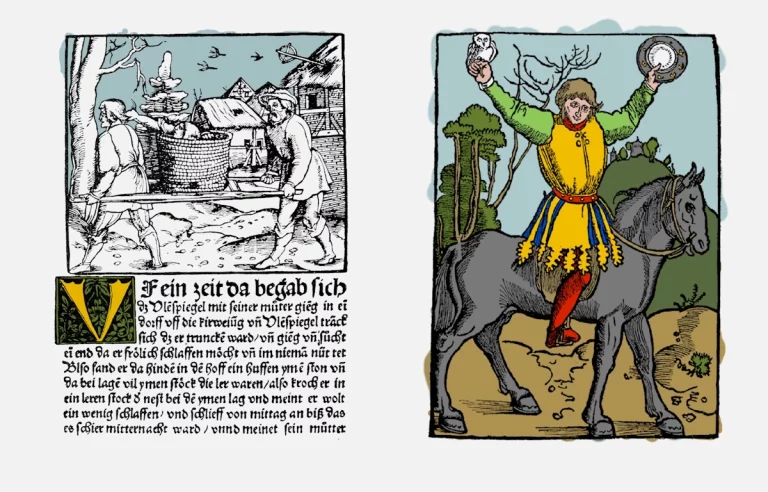
A medieval jester who turned foolishness into an art form, one prank at a time.
Bugs are here to stay; we have them ready on display. We remove the backgrounds and the occasional stain, so enjoy these insect images of the public domain!
Escape misery with Aqua Tofana: the discreet, deadly solution for oppressive marriages!

Barbershop poles hide a bloody past of surgery, bloodletting, and everyday medical practice.
Every year lakes and rivers are filled with thousands of pacific salmon still alive and swimming, yet rotting away.