A Gentleman's Guide to 1910's Fashion
Men’s fashion in the 1910s sits at an interesting crossroads. At first glance, it carries the polish and restraint of the late Victorian and Edwardian years, with their strict rules and carefully tailored silhouettes. Look a little closer, though, and you start to see the cracks. The decade was restless. Industry was speeding up, cities were growing, and social roles were shifting. Clothes began to respond.
Early in the decade, a well-dressed man still aimed for a composed, almost architectural look. Clean lines, fitted waists, and carefully chosen fabrics defined the ideal. By the time the decade closed, practicality had begun to edge out ceremony. War played a major role in this transformation, but even before that, the mood was changing. Men wanted clothing that could move with them, not hold them in place.
The result was a style that balanced refinement with a growing sense of ease. It never quite abandoned elegance, but it stopped clinging to it so tightly.
Suits and Formal Wear: Structured Style with a Twist
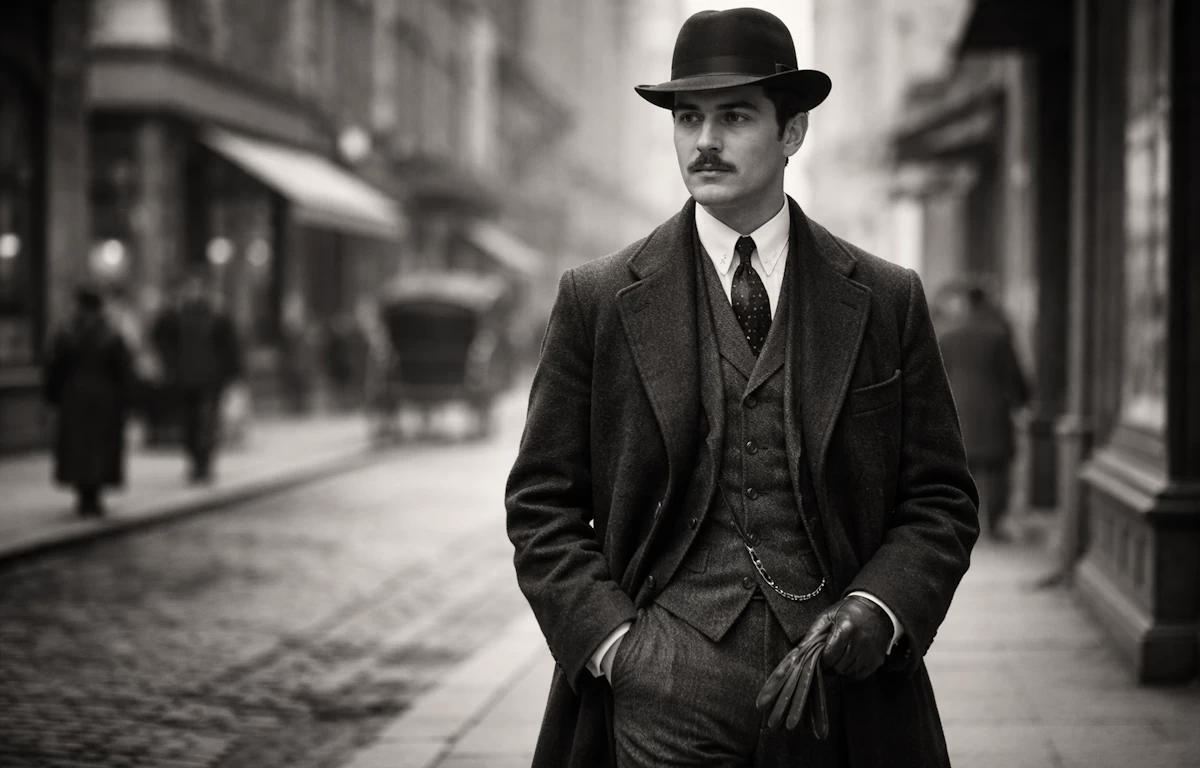
The suit remained the backbone of a gentleman’s wardrobe, though its shape began to loosen ever so slightly. Jackets in the early 1910s still followed a fitted silhouette, with narrow shoulders and a waist that tapered in. This created a clean, upright posture that signaled discipline and control. Lapels were modest in width, often peaked or notched, and fabrics leaned toward darker tones such as charcoal, navy, and deep brown.
What changed over time was the rigidity. As the decade progressed, jackets became a touch less restrictive. The padding softened, and the waist suppression relaxed. Trousers followed a similar path. Early in the decade, they were fairly slim and sharply creased, sitting high on the waist and often held up with braces. By the later years, a slightly fuller cut began to appear, offering greater comfort without sacrificing form.
Formal wear still held its ground. Morning coats, tailcoats, and waistcoats remained essential for certain occasions. Yet even here, subtle shifts occurred. Waistcoats began to show a bit more variation in fabric and color, introducing small opportunities for personal expression. The gentleman of 1910 might dress by the book, but by 1919 he had started to annotate it.

Shirts and Collars: When Starch Was King
If there is one element that captures the discipline of early 1910s fashion, it is the collar. These were not the soft, forgiving collars familiar today. They were detachable, heavily starched, and designed to stand firm throughout the day. High and stiff, they framed the face with an almost sculptural precision.
Different collar shapes carried different connotations. The wing collar, with its small folded points, was associated with formal evening wear. The more common turn-down collar offered a slightly softer look, though it still maintained a crisp edge. Men often owned multiple collars, swapping them out as needed while reusing the same shirt body. This was practical, but it also ensured that the most visible part of the shirt remained spotless.
Shirts themselves were typically made of cotton and tended toward light colors, with white being the standard. Subtle stripes or faint patterns could appear, though they stayed understated. Over time, collars began to soften. By the latter part of the decade, attached collars gained popularity, hinting at a broader move toward comfort and convenience.
Ties and Bowties: Neckwear That Mattered
Neckwear in the 1910s was far from an afterthought. It played a central role in pulling an outfit together, offering one of the few areas where a man could show a bit of personality. Ties were generally narrower than those seen in later decades, and they were often tied in simple knots that emphasized neatness over flair.
Silk was a favored material, lending a subtle sheen that complemented the rest of the ensemble. Patterns ranged from restrained stripes to small geometric designs, with colors that coordinated rather than clashed. A tie was expected to harmonize with the shirt and suit, not compete with them.
Bowties held their own place, particularly in formal settings. They carried an air of tradition and were often paired with evening wear. Yet even outside strictly formal occasions, some men preferred them for their compact and tidy appearance.
What stands out is the care given to proportion. The width of the tie, the spread of the collar, and the shape of the knot all worked together. A mismatch could throw off the entire look. A well-chosen tie, on the other hand, quietly elevated everything around it.
Outerwear: Coats That Did More Than Keep You Warm
Outerwear in the 1910s served both practical and stylistic purposes. Coats were expected to provide warmth, of course, but they also completed the silhouette. A man stepping outside without the right coat could feel underdressed, no matter how fine his suit.
The overcoat was a staple, often cut long and designed to drape cleanly over the body. Wool dominated, valued for its durability and insulating qualities. Dark shades remained common, though lighter tones could appear during the day or in milder seasons.
More specialized garments also had their place. The trench coat, which gained prominence during the war, combined functionality with a certain rugged appeal. Its belted waist and practical features made it well suited to both military and civilian life. Meanwhile, heavier coats such as ulsters offered additional protection against harsh weather, with thick fabrics and generous cuts.
Details mattered here as well. The shape of the collar, the placement of buttons, and the overall length of the coat all contributed to the final impression. Even in foul weather, a gentleman was expected to look composed.
Accessories: The Devil’s in the Details
Accessories in the 1910s were subtle but significant. They did not dominate an outfit, but they quietly reinforced its tone. A pocket watch, often attached to a chain and tucked into a waistcoat, served as both a functional item and a mark of refinement. The simple act of checking the time could become a small performance.
Cufflinks provided another opportunity for detail. These could range from plain and understated to slightly decorative, though they rarely crossed into extravagance. Their purpose was to secure the cuffs while adding a hint of polish.
Gloves were commonly worn, particularly in cooler weather or for formal occasions. Leather was a popular choice, offering both durability and a clean appearance. Walking sticks and canes, while less essential, still appeared as markers of status or personal style.
Each accessory had its place. None were meant to overwhelm the ensemble. Instead, they worked together to suggest care, discipline, and attention to detail.
Footwear: The Foundation of Fashion
Shoes in the 1910s were built to last, and they looked the part. Leather was the material of choice, with a focus on durability and a well-maintained finish. Black and brown dominated, with the choice often guided by the formality of the occasion.
Boots remained common, especially in the earlier years of the decade. They offered support and protection, and they paired well with the tailored lines of a suit. As time went on, lower-cut shoes became more widespread, reflecting a gradual shift toward convenience.
The condition of one’s footwear spoke volumes. A polished shoe suggested discipline and self-respect, while a scuffed or neglected pair could undermine an otherwise careful outfit. Men were expected to maintain their shoes regularly, keeping them clean and properly shined.
There was also a sense of proportion at work. The shape of the shoe needed to complement the cut of the trousers. A bulky shoe could disrupt the line, while a well-chosen pair reinforced it.
Hats: Top Off the Look
No gentleman of the 1910s would consider stepping outside bareheaded. Hats were an essential part of daily dress, serving both practical and social functions. They protected against the elements, but they also signaled respectability.
The bowler hat remained a popular choice, with its rounded crown and firm structure. It conveyed a sense of reliability and was widely worn in urban settings. The fedora began to gain ground as well, offering a slightly softer shape and a touch more versatility.
For formal occasions, the top hat still held its place. Tall and unmistakable, it carried a sense of ceremony that few other items could match. Even as fashion evolved, the top hat remained tied to tradition.
Hats also introduced an element of individuality. The angle at which a man wore his hat, the condition of the brim, and the choice of style all contributed to his overall presentation. It was a small detail, but one that rarely went unnoticed.
The World War I Effect: Practicality Takes Over
The outbreak of World War I in 1914 brought significant changes to men’s clothing. Uniforms took precedence for those in service, and their influence extended into civilian fashion. Practicality became more important, and certain formalities began to fade.
Fabric shortages and the demands of wartime production led to simpler designs. Excess decoration fell out of favor, and garments were often made with efficiency in mind. This shift did not erase style, but it did reshape it.
After the war, many men returned home with a different perspective. They had experienced clothing that prioritized function, and this left its mark. The rigid structures of earlier years began to loosen further, setting the stage for the more relaxed styles of the 1920s.
Conclusion: 1910s Men’s Fashion—A Blend of Elegance and Evolution
Men’s fashion in the 1910s tells a story of transition. It begins with a firm grip on tradition, with its structured suits, starched collars, and carefully chosen accessories. Over time, that grip loosens. Comfort, practicality, and subtle self-expression begin to find their place.
What makes the decade compelling is this balance. It never fully abandons its sense of order, yet it clearly moves toward something more flexible. The result is a style that feels both composed and alive, shaped by the pressures and possibilities of a changing world.
For the modern reader, it offers more than a snapshot of clothing. It shows how fashion responds to larger forces, adapting while still holding onto its core identity. And if nothing else, it leaves you with a quiet appreciation for a well-tied tie and a properly polished pair of shoes.