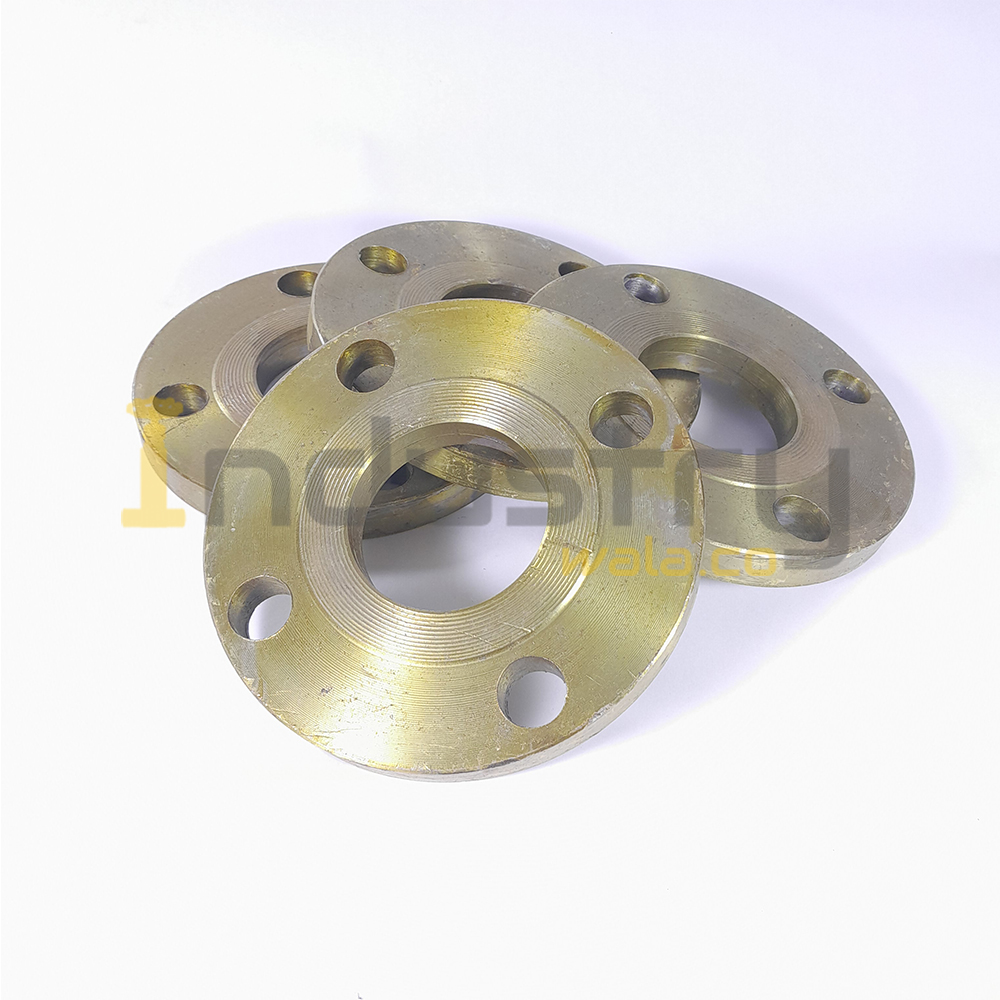
A flange is a method of connecting pipes, valves, pumps and other equipment to form a piping system. It also provides easy access for cleaning, inspection or modification. Flanges are usually welded or screwed. Flanged joints are made by bolting together two flanges with a gasket between them to provide a seal. The most used flange types in Petro and chemical industry are:- 1) Weld neck 2) Slip On 3) Socket weld 4) Lap joint 5) Threaded 6) Blind Materials for Flanges Pipe flanges are manufactured in all the different materials like stainless steel, cast iron, aluminium, brass, bronze, plastic etc. but the most used material is forged carbon steel and have machined surfaces. In addition, flanges, like fittings and pipes, for specific purposes sometimes internally equipped with layers of materials of a completely different quality as the flanges themselves, which are “lined flanges”. The material of a flange, is basically set during the choice of the pipe, in most cases, a flange is of the same material as the pipe. All flanges, discussed on this website fall under the ASME en ASTM standards, unless otherwise indicated. ASME B16.5 describes dimensions, dimensional tolerances etc. and ASTM the different material qualities. For IBR Certified Flange, click here. For Blind Flanges, Click Here. FAQs – CS Slip On Flanges Table D/E/F/H/ Class 150#/300#: 1. How do CS Slip On Flanges ensure secure and leak-free piping connections in industrial systems?These flanges provide a reliable welded joint that enhances sealing strength, making CS Slip 300 table flanges ideal for stable and leak-proof flow connections in various pressure classes. 2. Are CS Slip On Flanges suitable for both low and medium-pressure applications across different standards?Yes, CS Slip 300 table flanges are available in multiple tables (D/E/F/H) and classes (150#/300#), allowing compatibility with diverse pressure and piping requirements. 3. Does the slip-on design simplify installation and alignment during piping assembly?Absolutely. The slip-on structure of CS Slip 300 table flanges allows easy pipe insertion and accurate alignment before welding, improving installation efficiency. 4. Can CS Slip On Flanges maintain long-term durability in demanding industrial environments?Yes, the carbon steel build makes CS Slip 300 table flanges strong, corrosion-resistant, and suitable for high-performance use in oil, gas, water, and steam systems. SKU: f42733f34301 Categories: MS Flanges, Non IBR Pipe Fittings and Flanges, Pipe Fittings & Flanges, Slip On Flanges Tags: cs flange, flange, ms flange, s/o flange, slip on flange, ss flange